Leaderboard

Popular Content
Showing content with the highest reputation on 01/14/2026 in Posts
-
Reentrant execution may be a safe option. Have to check the function. The zlib library is generally written in a way that should be multithreading safe. Of course that does NOT apply to accessing for instance the same ZIP or UNZIP stream with two different function calls at the same time. The underlaying streams (mapping to the according refnums in the VI library) are not protected with mutexes or anything. That's an extra overhead that costs time to do even when it would be not necessary. But for the Inflate and Deflate functions it would be almost certainly safe to do. I'm not a fan of making libraries all over reentrant since in older versions they were not debuggable at all and there are still limitations even now. Also reentrant execution is NOT a panacea that solves everything. It can speed up certain operations if used properly but it comes with significant overhead for memory and extra management work so in many cases it improves nothing but can have even negative effects. Because of that I never enable reentrant execution in VIs by default, only after I'm positively convinced that it improves things. For the other ZLIB functions operating on refnums I will for sure not enable it. It should work fine if you make sure that a refnum is never accessed from two different places at the same time but that is active user restraint that they must do. Simply leaving the functions non-reentrant is the only safe option without having to write a 50 page document explaining what you should never do, and which 99% of the users never will read anyways. 😁 And yes LabVIEW 8.6 has no Separated Compiled code. And 2009 neither.1 point
-
A Timestamp is a 128 bit fixed point number. It consists of a 64-bit signed integer representing the seconds since January 1, 1904 GMT and a 64-bit unsigned integer representing the fractional seconds. As such it has a range of something like +- 3*10^11 years relative to 1904. That's about +-300 billion years, about 20 times the lifetime of our universe and long after our universe will have either died or collapsed. And the resolution is about 1/2*10^19 seconds, that's a fraction of an attosecond. However LabVIEW only uses the most significant 32-bit of the fractional part so it is "only" able to have a theoretical resolution of some 1/2*10^10 seconds or 200 picoseconds. Practically the Windows clock has a theoretical resolution of 100ns. That doesn't mean that you can get incremental values that increase with 100ns however. It's how the timebase is calculated but there can be bigger increments than 100ns between two subsequent readings (and no increment). A double floating point number has an exponent of 11 bits and 52 fractional bits. This means it can represent about 2^53 seconds or some 285 million years before its resolution gets higher than one second. Scale down accordingly to 285 000 years for 1 ms resolution and still 285 years for 1us resolution.1 point
-
Well I referred to the VI names really, the ZLIB Inflate calls the compress function, which then calls internally the inflate_init, inflate and inflate_end functions, and the ZLIB Deflate calls the decompress function wich calls accordingly deflate_init, deflate and deflate_end. The init, add, end functions are only useful if you want to process a single stream in junks. It's still only one stream but instead of entering the whole compressed or uncompressed stream as a whole, you initialize a compression or decompression reference, then add the input stream in smaller junks and get every time the according output stream. This is useful to process large streams in smaller chunks to save memory at the cost of some processing speed. A stream is simply a bunch of bytes. There is not inherent structure in it, you would have to add that yourself by partitioning the junks accordingly yourself.1 point
-
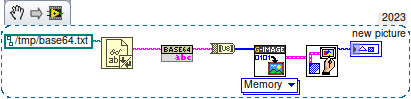
So in LV>=20, using OpenSerializer.Base64 and G-Image. That simple. Linux just does not have IMAQ. Well, who said that the result should be an IMAQ image?
 1 point