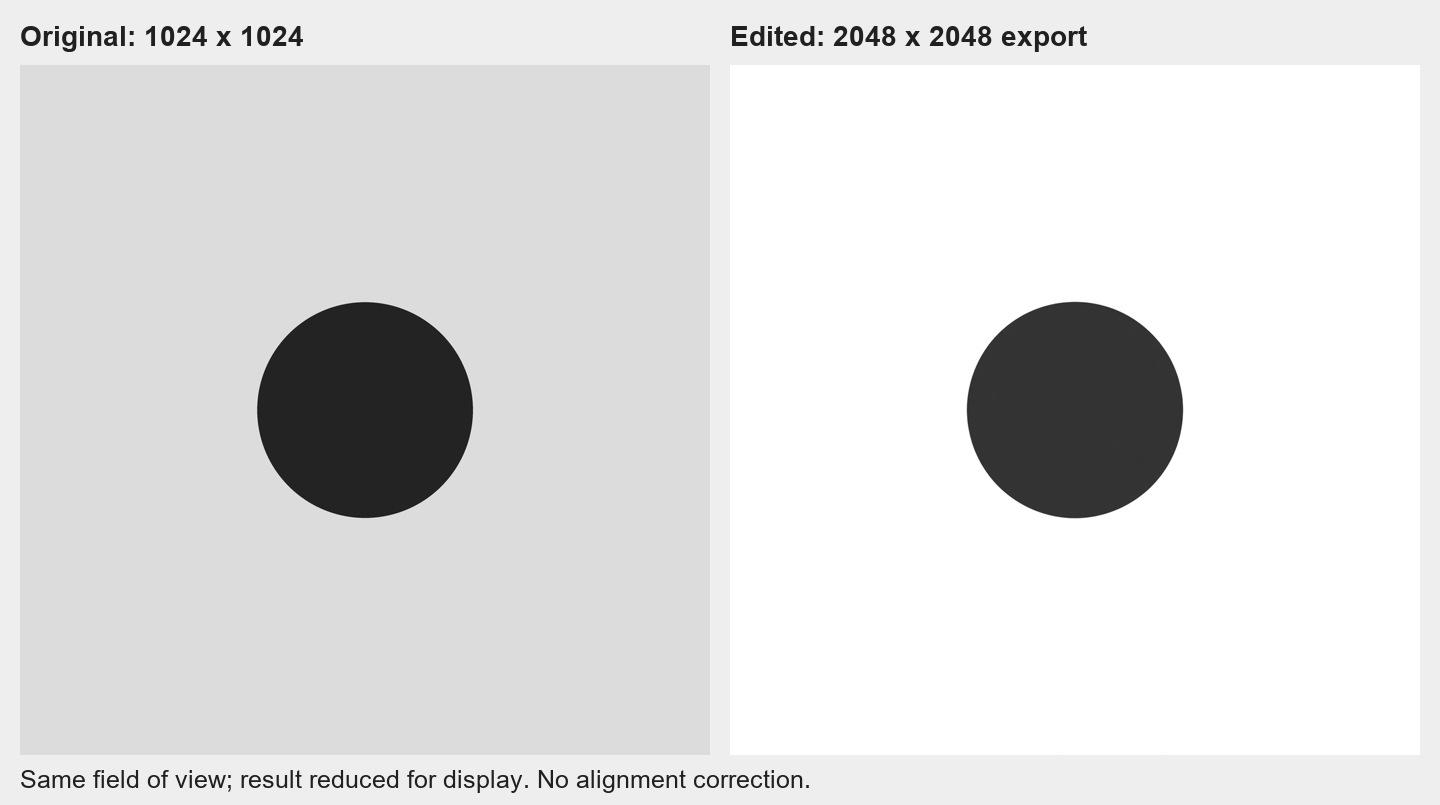
I wanted an additional image for checking how a threshold separates a dark object from a lighter background. The intended change was the background; the disc was supposed to stay fixed, so I could compare the two inputs against the same foreground mask.
Before using the edited image that way, I checked whether those conditions still held. The two background regions I measured were almost uniform, but brighter than requested. The disc kept the same bounding box, while its threshold mask differed slightly. That distinction matters when deciding whether to reuse the original expected mask or establish a new baseline.
A simple reference with a known baseline
I drew the original locally: a 1024 × 1024 RGB PNG with a nominally centred dark disc on RGB 220,220,220. The disc was drawn at four times the resolution and reduced with Lanczos antialiasing. Its raster mask, rather than an ideal mathematical circle, is my baseline.
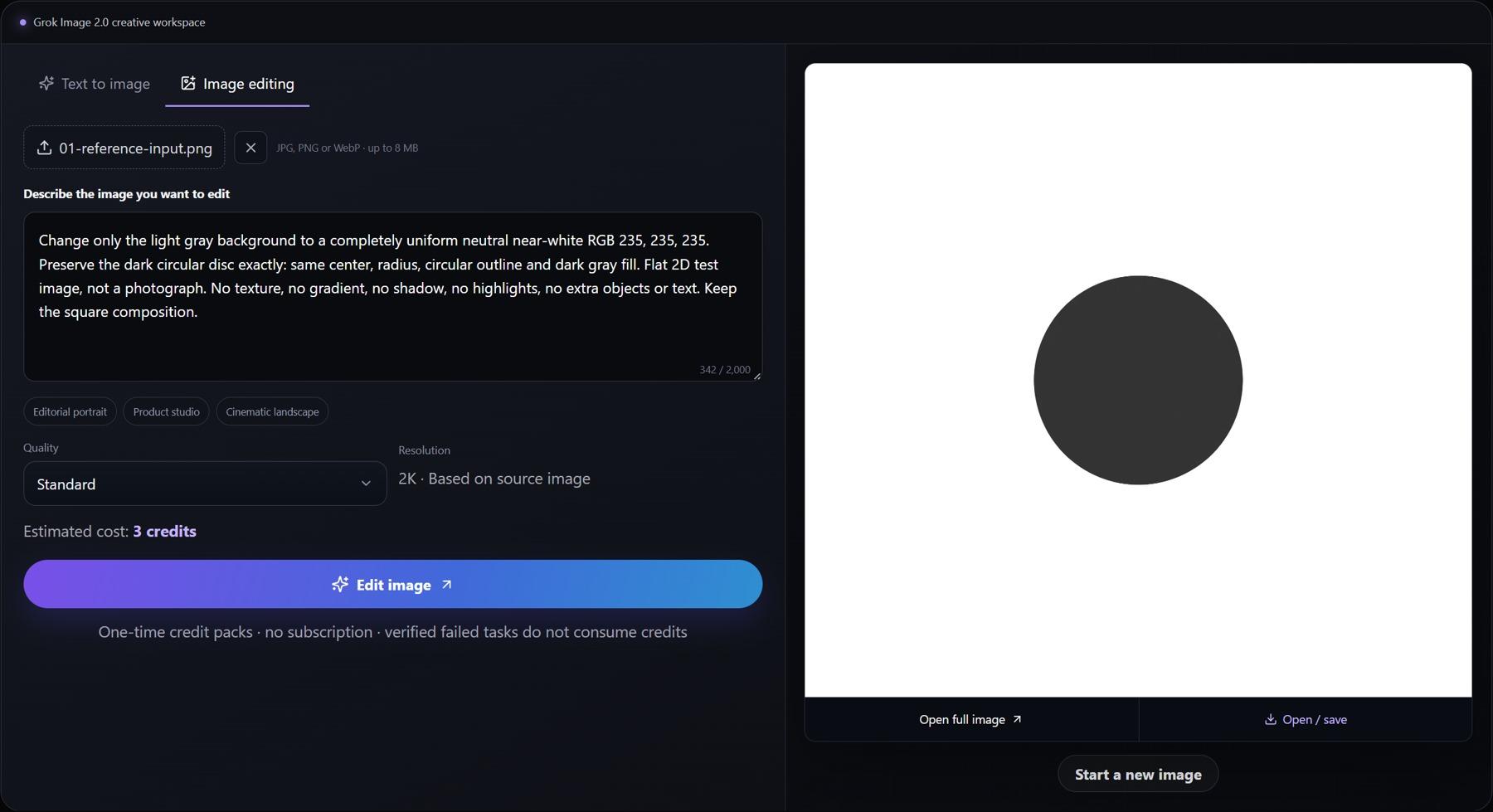
For an exactly specified flat background, I would normally change the pixels directly. Here I used a deliberately simple image to check what a background-edit request preserved before treating its output as a supplementary vision input. I submitted it once to the Image editing workspace on Grok Image 2.0, using Standard quality. I run that site; the measurements below were performed separately. The interface showed “2K · Based on source image”; the downloaded result was a 2048 × 2048 JPEG. The instruction was:
Change only the light gray background to a completely uniform neutral near-white RGB 235, 235, 235. Preserve the dark circular disc exactly: same center, radius, circular outline and dark gray fill. Flat 2D test image, not a photograph. No texture, no gradient, no shadow, no highlights, no extra objects or text. Keep the square composition.
A flat background and an unchanged mask are separate checks
These checks were performed in Python with Pillow and NumPy, not in LabVIEW/IMAQ. I reduced the output to 1024 × 1024 with Lanczos, without alignment or tonal correction, and calculated Y = 0.299R + 0.587G + 0.114B from the encoded eight-bit channel values.
Two background ROIs used zero-based, half-open coordinates: x/y 64:320 in the upper left, and x/y 704:960 in the lower right. Both original ROIs had mean 220 and standard deviation 0. The edited ROIs had means of approximately 255 and standard deviations of 0.022 and 0.023. They were very flat, but roughly 20 levels brighter than the requested 235. Two ROIs do not establish uniformity across the entire background.
Using the same foreground rule, Y < 100, on both images:
The inclusive bounding box remained x/y 352:671, or 320 × 320 pixels.
Foreground area changed from 80,406 to 80,611 pixels: about +0.255%.
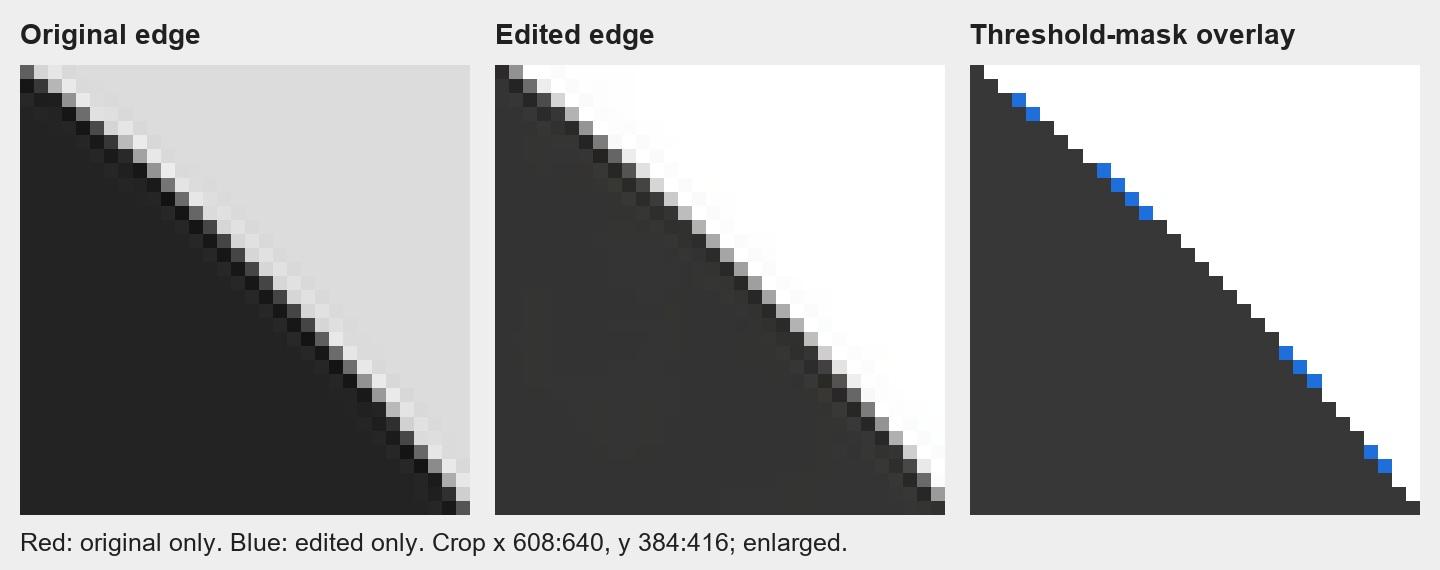
The masks disagreed at 213 pixels; intersection over union was 0.99736.
The overlay is a local analysis image. The 213 differing pixels show that an unchanged bounding box does not guarantee an identical threshold mask. They do not establish geometric deformation or a failure in a downstream vision task. These numbers describe the complete edit/export/resampling path, including JPEG encoding and Lanczos reduction, and depend on the chosen threshold.
For this specific requirement—background level 235 and the original mask unchanged—I would not use the output with the original expected values. I would construct that controlled input deterministically. If I kept the generated image as an exploratory case, I would label its provenance and measure its own baseline; it could supplement real camera images, but would not establish performance on them.
This is an input-preparation check, not a LabVIEW/IMAQ result. For those maintaining vision regression sets there, how do you distinguish inputs that must preserve an existing mask from exploratory images that need their own measured baseline?