
jmog
-
Posts
2 -
Joined
-
Last visited
jmog's Achievements





-
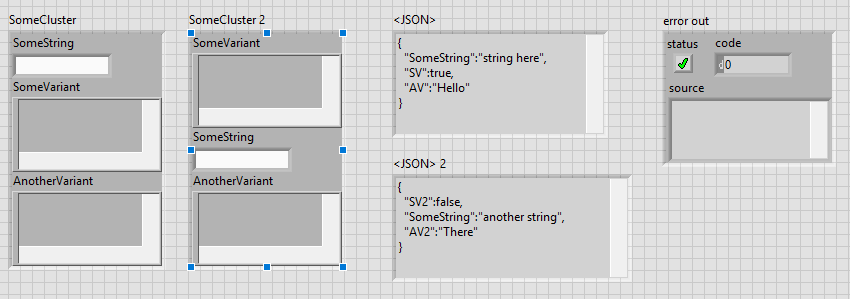
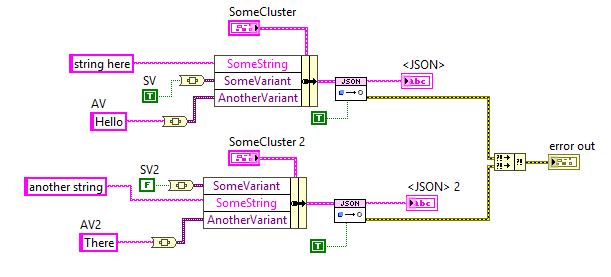
Can't find a way to edit my previous post, so continuing here. After posting, I found the related discussion on page 7 of this thread. So apparently the variant names that get used in the resulting JSON string are not the name fields of the cluster, but rather the names of the pieces of data inside the variant. This feels very counterintuitive to me, but in case someone is running into the same issue, at least one solution is to name the data used inside the variant (see image below). Would it be possible to use the names of the fields in the cluster instead of the names inside the variant? That would feel more intuitive to me and apparently several others as well.

-
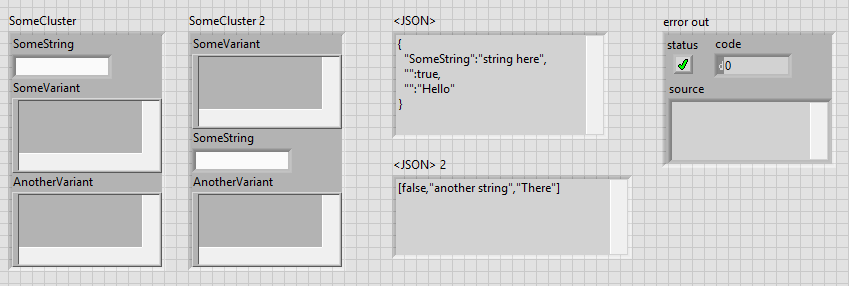
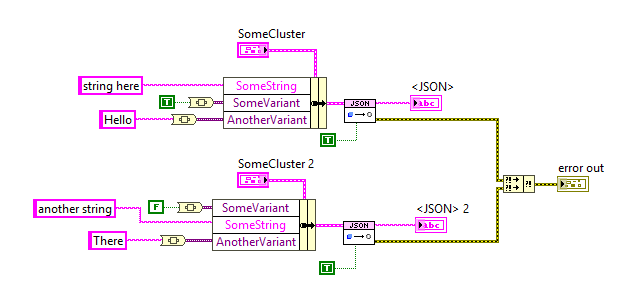
Hi! Thanks for the awesome tool. I am seeing an issue that was reported also earlier in this thread (page 3), but I didn't see any further discussion about it. The problem is 'To JSON Text.vim' not handling variant names, when converting from LabVIEW data type to JSON string. I am trying to convert a cluster that has some variant fields, but in the resulting JSON string the variant field names are empty. More over, if I have a variant as the first field in my cluster, the resulting JSON string is actually a JSON array instead of an object (which, according to documentation, should be the case, if the first field in the cluster is unnamed). To my understanding my variant fields do have names. Is this a bug or some mistake in my end? Here are some snips from a test VI to demonstrate the issue.