
drjdpowell
-
Posts
1,994 -
Joined
-
Last visited
-
Days Won
183
Content Type
Profiles
Forums
Downloads
Gallery
Everything posted by drjdpowell
-
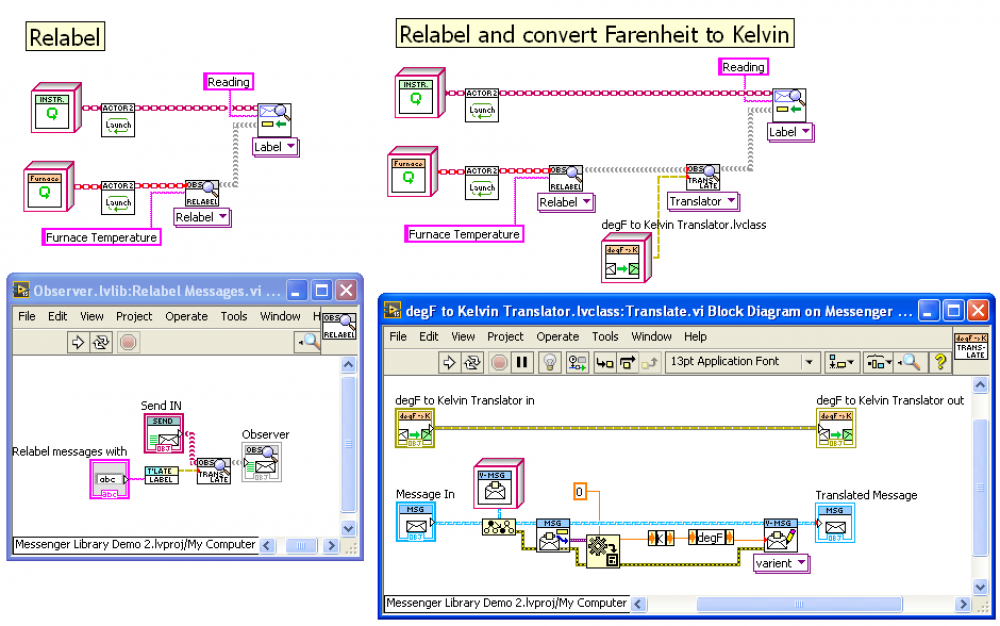
Here is an illustration of what Thoric is discussing. Calling code starts two actors: an “Instrument" actor that is publishing a “Readingâ€, and a “Furnace†actor that expects to receive “Furnace Temperature†messages. If the two messages both use the same data format (a numeric in Kelvin, say) then we use the code on the left to connect the two actors directly. We configure the messages to be relabelled with the “Translate†polymorphic VI. Looking inside that API call we see that we are providing a “Translator†child class to actually do the relabelling. However, if Instrument publishes its “Reading†as Kelvin, but the Furnace expects “Furnace Temperature†to be in Fahrenheit (horror!) then we can supply a custom child Translator class. This class only needs one method, an override of “Translate.vi†(shown), which adapts the messages to the form required by Furnace. We provide this as a second translator as shown in the code at right. [Opps: just noticed I misnamed the Translator child class as degF to Kelvin when it is really Kelvin to degF]

-

Pop Quiz, LabVIEW Experts
drjdpowell replied to alecjcook's topic in Application Design & Architecture
That’s not a “poolâ€. That is three independent clones. A pool is when you don’t care which instance you are talking to. -
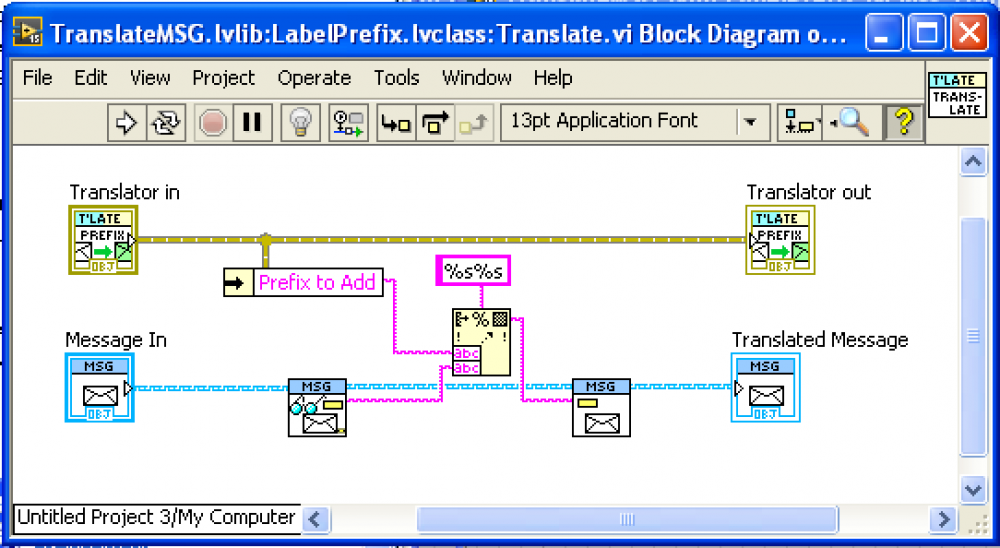
Hi Thoric, As a quick aside to other readers let me note that it is a goal of Messenger Library that one NOT have to be a whiz at LVOOP to use it. The standard API is meant to be used by itself to make inter-loop communication easier, without the need to create new classes. But because it is based on LVOOP internally, one can extend it powerfully using inheritance. So with the proviso that these are “optional bonus power ups†that are rarely used, then yes, the “Translation†polymorphic VI on the “Observer†pallet is specifically intended for one to alter messages. The standard translations that I use commonly are “Relabelâ€, “Add Prefixâ€, and “Outer Envelopeâ€, but there is also “Add Translatorâ€, which allows one to provide a custom child class of “Translator.lvclassâ€. The only method that must be overriden is “Translate.viâ€, though you may want a creation method if your Translator need internal info. See the “LabelPrefix.lvclass†for an example. The “Translation†method is quite straight forward (see an example below). Even more generally, the “Send†parent class, usually thought of as a generic “addressâ€, can also be considered a “Callbackâ€. The “Reply†and “Notify†API methods are really callback hooks, where calling code can “hookup†functionality to an actor. The only important restriction is that the callbacks should not interfere with the operation of the actor (such as by blocking or taking an unreasonable time to execute). So one could do things like average data before it is sent, or log debugging information, for example. BUT, don’t get too fascinated by the fancy tools in the toolbox. Most of my messages contain only one piece of data. — James PS, if you want to explore another powerful LVOOP class that can be extended, look at “Async Action.lvclassâ€, which is intended to make it easy to make actions that can be run in parallel to any loop (with action results sent back in a message).
-
It come up in JSON to Variant, where the User of the library provides a target cluster containing their custom child classes. I need to provide a Variant that can be converted using Variant-to-Data into their cluster. My workarounds are: 1) require the User to override a “Put in Variant†dynamic dispatch method. Very simple, just puts the object in a Variant with the right wiretype, but a burden on the User. 2) get as LVObj; flatten to string; unflatten using the type descriptor from the supplied child object. This allows one to ‘transfer’ the wiretype into the Variant. But the flattening/unflattening is heavy overhead.
-
Pop Quiz, LabVIEW Experts
drjdpowell replied to alecjcook's topic in Application Design & Architecture
Stop using the 0x40 pool option. You don’t want a reference to pool of clones. Try just 0x8. -
Pop Quiz, LabVIEW Experts
drjdpowell replied to alecjcook's topic in Application Design & Architecture
Not sure how 0x8 and 0x40 options interact, but with 0x40 you are creating three shared clone pools, so the answer would be three values between 1 and 3, depending on how LabVIEW assigns idle clones in the pool. With just 0x8, you’re making three clones, and the answer is [3,3,3]. -
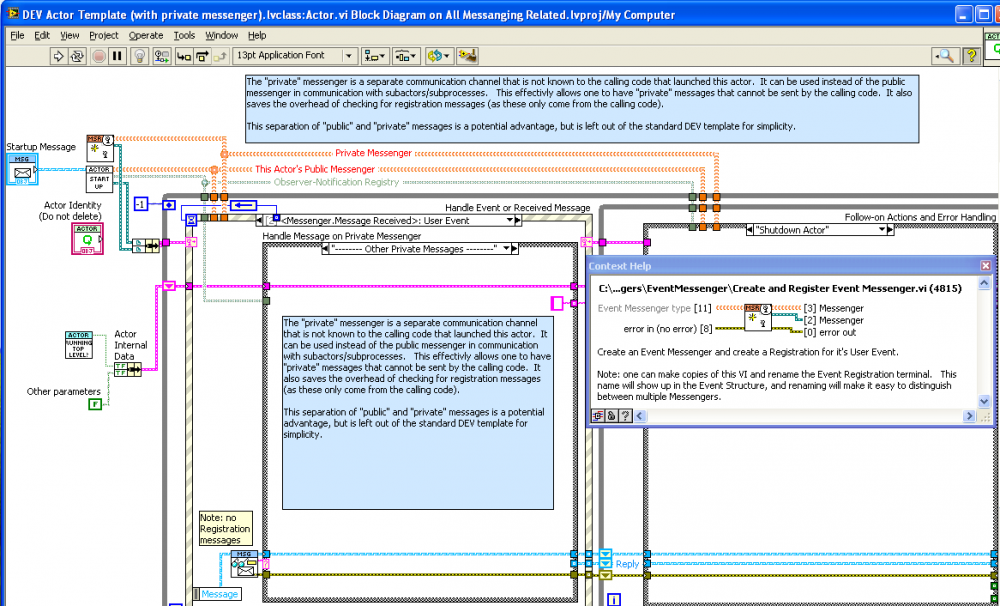
Darn. I actually had a DEV template modification that demonstrates some of this, but I removed it from the published package because I thought it was too niche. See a screenshot below. I also need to use a subVI to name the event registration. You can also see a “Private Messenger†in the JKI Actor Template. Note, BTW, that I don’t use EventMessengers in the way you are: a different Messenger for each message. Instead I have multiple messages coming in through one event case, with a case structure on the message label. The only reason I sometimes have a second EventMessenger is to separate “Public†(or “Externalâ€) messages from calling code, from “Private†(or “Internalâ€) messages coming from my subActors. So I can prevent calling code from being able to send me private messages, and I can limit what subActors can do (like not tell me to shutdown, for example).
-
The second option. PS> I’m a bit stuck on this at the moment because of a problem with “Variant to Data†being too “dumb†when it comes to child classes. If one has a Variant containing a Parent-class datatype holding a child-class object, and you attempt to use "Variant to Data" to cast this to a Child-class wire, it throws a type mismatch error, even though such a conversion is easily possible. This is a problem when the library-user want to use clusters containing their own child classes. There are a couple of work around but both are ugly.
-
sqlite SQLite Library 1.6 beta: Attributes lookup table
drjdpowell replied to drjdpowell's topic in Code In-Development
The JSON SQL functions should be working in this beta (I think it includes the 3.9.0 dll with those functions). I’ve only played around with them a little, but they do work. -
Oh, I’m not even talking about a framework. Just a hook that allows someone to connect such a thing to the JSON-Variant tools without modifying JSON.lvlib. Then CharlesB could provide his object serializer as an addon library.
-
I suggest you just decimate your data after the filter.
- 3 replies
-
- 2
-

-
- peak detection
- fir
- (and 1 more)
-
Note: I’m thinking of putting in an abstract parent class with “To JSON†and “From JSON†methods, but I’m not going to specify how exactly objects will be serialized. So Charles can override with his implementation (without modifying JSON.lvlib) without restricting others from creating classes than can be generated from different JSON schema. I could imagine use cases where one is generating objects from JSON that is created by a non-LabVIEW program that one cannot modify, for example. Or one just wants a different format; here’s a list of objects from one of my projects: [ ["SwitchRouteGroup",{"Connect":"COMMS1"}], ["DI Test",{"IO":"IO_ID_COMMS_1_PRESENT","ON=0":false,"Value":true}], ["Set DO",{"IO":"IO_ID_COMMS_1_EN","ON=0":true,"Readable?":true,"Value":false}], ["Wait Step",{"ms":2000}], ["DMM Read Voltage",{"High":2,"Low":-2}], ["Set DO",{"IO":"IO_ID_COMMS_1_EN","ON=0":true,"Readable?":true,"Value":true}], ["Wait Step",{"ms":500}], ["DMM Read Voltage",{"High":13,"Low":11}], ["AI Test",{"High":3600,"IO":"IO_ID_COMMS_1_V_SENSE","Low":3400}], ["SwitchRouteGroup",{"Disconnect":"COMMS1"}] ]
-
I could easily make a “JSON serializable†class with abstract “Data to JSON†and “JSON to Data†methods, and have the JSON-Variant tools use them. Then you could inherit off this class and not have to modify JSON.lvlib.
-
I would Google “CRC16 LabVIEW†first, if I were you, and see if you can find it already done for you.
-
Problems show up in the unflattening part. Flattening, the part you are trying, is strait forward, because you are going from strongly-typed LabVIEW to weakly-typed JSON. The other way is harder. You don’t need to make your class a child of JSON Object; just have your class have “To JSON†and “From JSONâ€. You won’t be able to use these objects in the JSON-Variant tools, but you will be able to handle things with the other methods. This involves more coding, but is faster. And it allows one to get away from the monster config cluster and towards a distributed config, where different code modules supply different parts of the config.
-
The current JSON-Variant tools will store objects as flattened strings. Not human-readable, but flattened objects have a mutation history so you can freely rearrange things inside the class private data (but not on any condition re-namespace the class). I find that mixed-mode quite useful and easy. Alternately, to serialize objects as JSON I usually just have methods in the class to convert to/from JSON and I use them as I build up the JSON explicitly (i.e. without using the shortcut of the JSON-Variant tools on a cluster). There is a possibility that one could make one’s LVOOP classes children of “JSON Valueâ€, and then override “flatten†and “unflattenâ€. Then your objects would serialize to JSON even inside a cluster using the JSON-Variant tools (those tools recognize “JSON Value†objects and flatten/unflatten them). But there is a technical issue that I have to look into to make that work. [Never mind, this won’t work.] Adding or removing is fine, but don’t rename or move things, unless you want to have a “schema version†attribute and mutation code than coverts from older schema.
-
Ah, I see. We need something like Error 402864, SQLITE_BUSY(5), occurred at redacted.lvlib:redacted.vi on "INSERT OR IGNORE INTO redacted ( redacted, redacted, redacted) VALUES (?, ?, ?);" Possible reason(s): database is locked. See https://www.sqlite.org/rescode.html#busy. Edit> can’t do the above, but how about: Error 402864 occurred at redacted.lvlib:redacted.vi on "INSERT OR IGNORE INTO redacted ( redacted, redacted, redacted) VALUES (?, ?, ?);" Possible reason(s): SQLITE_BUSY(5) database is locked (see https://www.sqlite.org/rescode.html)
-
I add 402859 to the SQLite error code (apologies for that number, but those are the range of codes assigned to me by NI). I’m currently calling sqlite2_errmsg() to get an error description from the SQLite dll itself. And the message should have also contained either the database file, or SQL statement on which the error occurred. Was this information not in the error?
-
If you look in the latest beta version you’ll find it (though it’s not in the palettes, it is in the Connection class). PS> Some notes: — one can also use the last_row_ID() SQL function — Be careful that you aren’t executing multiple INSERT statements in parallel on the same Connection, as you might mixup the rowIDs. — note the existence of WITHOUT RowID tables, which avoids the need to determine the auto assigned rowID.
-
Here is a beta version with changes aimed at performance, particularly for large arrays of data. I managed to eliminate an O(N^2) performance issue with parsing large JSON strings. I also improved the Variant tools’ speed with one- and two-dimensional arrays. See the new example “Example of an Array of XY arrays.viâ€. lava_lib_json_api-1.4.1.33.vip Please give this a test and let me know of any issues before I place it in the CR. I’m also thinking of submitting to the LabVIEW Tools Network. — James
-
Sorry, forgot to push the changes. It’s there now.
-
Here is a Beta version with a new “Treatment of Infinity/NaN†terminal on the JSON write functions. Three options: -- Default JSON: write all as nulls. -- Extended: use JSON strings for Infinities ("Infinity", "-Infinity"); NaN still null. -- LabVIEW extentions (compatable with the LabVIEW JSON primatives): Infinity, -Infinity, NaN (not in quotes) Note that the LabVIEW extentions are not valid JSON. The Extended option IS valid JSON, but not all JSON parsers will process strings as numeric values. lava_lib_json_api-1.4.0.28.vip
-
I mean alternate treatments of Inf, -Inf, and NaN. I can think of alternatives that are arguably better than the choice made in the LabVIEW primitive. Personally, I would choose NaN==Null, Inf/-Inf==“Infinityâ€/“-Infinity†(strings), as this would be valid JSON. The LAVA JSON package should already be able to read this (I think). Regardless, other JSON packages that we may want to interact with may have made other choices.
-
It looks easy enough to add a Boolean to enable use of NaN, Infinity, -Infinity. It will have to be default False, though, as the default should be to meet the JSON standard. I would like to see this myself, as I use JSON mostly LabVIEW-to-LabVIEW. Maybe this should be an enum instead of a boolean, in case we want an alternate extension in the future? Not sure we can get default values of clusters in arrays (also, which array element should be used? First? Same Index?). As a work around, you can just index over the JSON Array elements in a FOR loop and convert each to a Cluster individually. Then you can either provide the same cluster as default, or have an array of different default clusters.
-
sqlite SQLite Library 1.6 beta: Attributes lookup table
drjdpowell replied to drjdpowell's topic in Code In-Development
No, but I’ll add the same NI off-pallet VIs used elsewhere in the library to convert to/from Mac paths: “Path to Command Line String†and “Command Line String to Pathâ€. Thanks. Do you use LabVIEW on the Mac? I haven’t in a long while and I could do with someone testing it. — James