
drjdpowell
-
Posts
1,994 -
Joined
-
Last visited
-
Days Won
183
Content Type
Profiles
Forums
Downloads
Gallery
Everything posted by drjdpowell
-

Action Engines... are we still using these?
drjdpowell replied to Neil Pate's topic in Application Design & Architecture
I have one User Event per “actor”, that basically carry Text-Variant messages. No maintenance at all. The main weakness of polling on “data changed” is that you can miss updates. -
Action Engines... are we still using these?
drjdpowell replied to Neil Pate's topic in Application Design & Architecture
My first thought is “consider doing views of past history for real and use SQLite”, as I’m sure you agree. My second thought is “that sounds trivial to do with the Register-Notify messaging pattern”. Why in the world would you message subsystems to get data in response? This is what I mean by focussing on a few complimentary techniques and learning them very well. SQLite is very complimentary, but if one mixes limited-capability messaging with some similarly simplistic “tag” implementation then you end up with an overly complex result that is weaker than just picking one technique and really understanding it. -
Action Engines... are we still using these?
drjdpowell replied to Neil Pate's topic in Application Design & Architecture
Oh yeah, there are quite a few “tag” libraries on NI.com. Using one of those might be better than rolling your own. I don’t use them because they wouldn’t give me anything I can’t do with messages, and they increase the amount of stuff I need to know (gotta know messaging, tags, and how tags interact with message timing). -
Action Engines... are we still using these?
drjdpowell replied to Neil Pate's topic in Application Design & Architecture
Single writer is good. Why “global” then? I generally have data flowing around by messages and locally stored by anyone who needs to store it. The other issue is constantly polling a DVR for changes, versus receiving notification messages only when things change, but for “slow” apps that doesn’t matter much (but it affects your ability to reuse your solution in “fast” apps). -
Action Engines... are we still using these?
drjdpowell replied to Neil Pate's topic in Application Design & Architecture
What are you “global storage needs”? How many writers are there of each data item? -
Action Engines... are we still using these?
drjdpowell replied to Neil Pate's topic in Application Design & Architecture
Hey, let’s infinite-loop the conversation! I should clarify. Message-handling loops, Action Engines, and by-ref classes can all be used to organize a complex application into subcomponents and control interactions between the subcomponents. The means of interacting may be different, async messages versus sync subVI/method calls, but the purpose of these structures is the same. Because they are different, but used for the same underlying purpose, I would recommend that a developer focus on one. It reduces complexity if you standardize, and allows you to really get competent at the techniques you have chosen. If asked, I would personally recommend using messages over any by-ref techniques, and also not using globally-accessibly things like standard AEs, but it is more important that one pick a technique and get good at it. -
Action Engines... are we still using these?
drjdpowell replied to Neil Pate's topic in Application Design & Architecture
Well, even at its most nebulous, “actors” interact by passing asynchronous messages, and are actively handling those messages. “Message-handling loops”, basically. That is significantly different than AE/DVRs, which passively wait to be synchronously called. More specifically, “actors” should follow the Actor Model, and I should probably have used the more generic "Message-Handling Loop” as a thing to compare with Action Engines. -
Action Engines... are we still using these?
drjdpowell replied to Neil Pate's topic in Application Design & Architecture
Eh? Where was that in the discussion? I was comparing AE's, DVR-based by-ref objects, and "actors". One can do complex or very simple things with any of them. -
Action Engines... are we still using these?
drjdpowell replied to Neil Pate's topic in Application Design & Architecture
Link title is "Passing Arguments by Value and by Reference" Ah, so you’re meaning pass by reference, as applied to arguments to function calls (terminals in LabVIEW), and some of the things we are talking about are not passed as arguments. I’m meaning “act on by reference”, or “having a reference to something”, meaning I have the means of acting on something that others also can act on. I don’t care if the reference is passed as an argument or is statically compiled in (like a Global or a subVI call). -
Action Engines... are we still using these?
drjdpowell replied to Neil Pate's topic in Application Design & Architecture
That weird design has always mystified me. The editing tools for the IPE structure are also painful. -
Action Engines... are we still using these?
drjdpowell replied to Neil Pate's topic in Application Design & Architecture
Yes, I also am not able to identify what you’re using the terms “by reference” and “by value” to mean, so I was trying to rephrase in different terminology in hopes we advance. -
Action Engines... are we still using these?
drjdpowell replied to Neil Pate's topic in Application Design & Architecture
Let’s try a different tack. There is an important difference between situations where one loop can affect another loop operating in parallel (a side effect), and where it cannot. Globals, Locals, DVRs, Queues, Notifiers, FGVs, Action Engines, or the new "Channels” are all means where one can “reach in” and affect a loop while it is running. Data on a wire is not. An interesting talk related to this by AQ: Why Dataflow Works: The Potato and Candy Explanation -
Action Engines... are we still using these?
drjdpowell replied to Neil Pate's topic in Application Design & Architecture
Branching makes copies; but the individual copies are not shared. Globals are by-ref. -
Connecting a GUI with the main loop
drjdpowell replied to Felipe's topic in Application Design & Architecture
Spend some time learning about Queues and User Events, and the concept of a loop handling messages. Forget about Get/Set invoke nodes. -
Action Engines... are we still using these?
drjdpowell replied to Neil Pate's topic in Application Design & Architecture
Ah, you mean the encapsulated data. Your right, but you talked about a “shared resource” that might need “mutexes”, which is about accessing things from processes running in parallel. By-value objects are not sharable and have no use for mutexes. -
Action Engines... are we still using these?
drjdpowell replied to Neil Pate's topic in Application Design & Architecture
Actors, AEs and by-ref classes can all be used as wrappers around shared resources that serialize parallel access to them and protect critical sections of code. They aren’t equivalent, but they have considerable overlap. -
Action Engines... are we still using these?
drjdpowell replied to Neil Pate's topic in Application Design & Architecture
I’m surprised there’s not more love for Action Engines. I’ve never really used them, but instead have focused on making “actors/processes” easy to make and communicate with, and on having by-value classes live wherever it’s natural for them to live. If they naturally need to live in an independent process, then it is easier for me to make it an actor than an Action Engine. I’m not really negative on Action Engines, but they don’t give me capability that I can’t get with an actor, and as hooovahh said, I can do active, periodic stuff with an actor. I only very rarely use actual by-ref objects (usually using a DVR). “ForceCalibration” would most likely by a by-value object for me, too. As a general programming principle, I believe one should standardize on a set of complimentary techniques (and get very good at those techniques), rather than mix multiple alternate ways of doing similar things. Action Engines, “actors”, and by-ref objects are different ways of doing the same thing, so one should pick the one you think is best and run with it. -
Have you looked at Help>>Find Examples.. and searched for an example of an intensity chart?
-
In the end, I decided to make my “Graph Augment" stuff a separate add-on package, so I don’t immediately need to switch up from 2011 in the main Messenger package. But I still think i will soon move up to LabVIEW 2013 anyway, for a number of minor reasons.
-
Try libLV_2835.*, as that means to use .dll or .so as applicable.
-
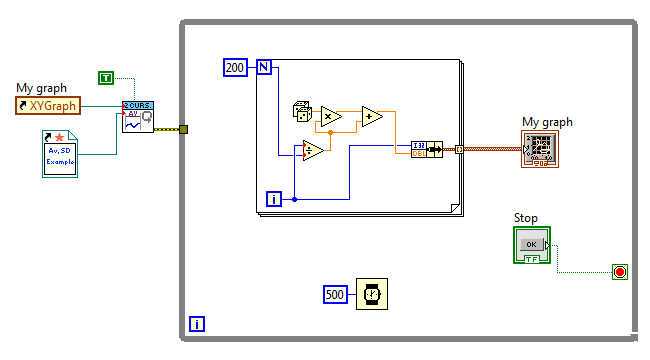
Forgot to add that a goal is to make adding functionality to controls easy, ideally a single subVI that can be called multiple times with different graph references. Customization is via references to simple subVIs used to generate the text. Below is the code of the first example.

-
JSON is an interchange format. Reducing coupling between components is what it’s meant for, so it’s sad that we worry about unwanted dependancies. The “variants that contain only strings and numerics as basic datatypes” that you are asking for are a much less flexible substitute to JSON text. I would not be happy if I had to do lots of manual type conversion on everything that isn’t a simple string; that’s an undesirable dependency to me. Really, the best solution would be for NI to realize the value of a JSON-like datatype and build that into LabVIEW, replacing this library entirely with a much faster solution that can be widely used in interfaces between modules without worrying about unwanted dependancies. As an alternative, have you considered using the JSON text itself as the thing to pass on, rather than a variant? Try this: replace your “data” Variant with a string labeled “<JSON>data”. That tag indicates to the library that you want your “data” subitem as JSON text. Pass that string across your subVI boundary. If you are just using strings and numerics, then your Caller can use the inbuilt JSON primitives to convert very quickly into data, so it isn’t dependent on this JSON library. Personally, I solved this issue by deciding to make this JSON Library a standard component always used in all cases where complex structured data is passed between modules. But then I did write the library.
-
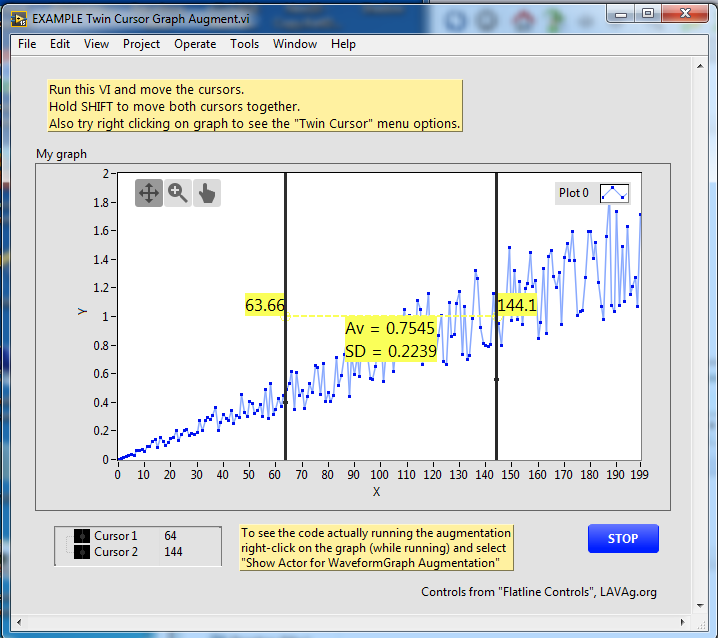
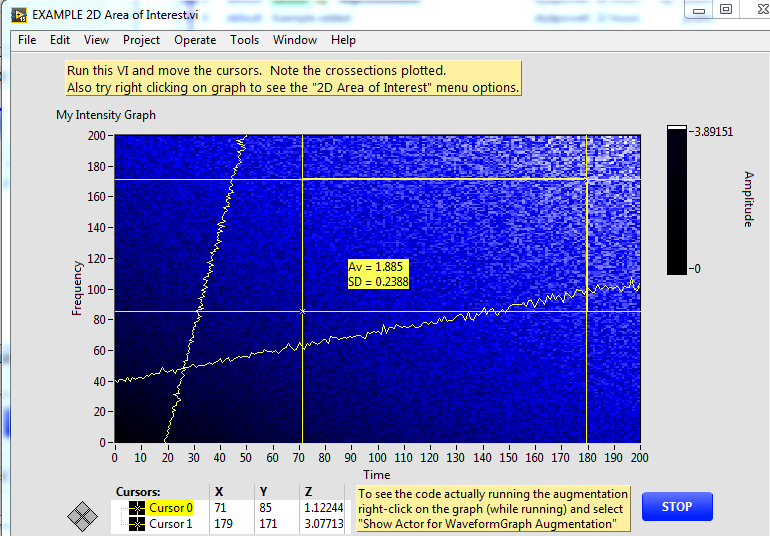
The attached VIPM contains an extension of Messenger Library that is intended to add extended functionality to controls/indicators, via a background process that is launched and which registers for the events of the control (the background process is a Messenger-Library “actor”). This is meant to be an alternative to XControls. Included are two “Augments”, both with examples. See <examples>/drjdpowell/UI Augments/Examples/EXAMPLE Twin Cursor Graph Augment. This takes any graph with two cursors and draws a line between the two and displays summary info of the data between the two cursors: There is also a cross-section plotting for a 2D intensity chart: This package is in LabVIEW 2015, and requires Messenger Library (latest, in the LAVA-CR) and JSON LabVIEW and Shortcut menu from Cluster (both in the LAVA-CR). drjdpowell_messenger_ui_augments-1.0.0.8.vip
-
I quickly tried this string and I didn’t get any error.
-
CRIO-style architecture for Raspberry Pi
drjdpowell replied to dmurray's topic in LabVIEW Community Edition
I tend to use subVIs one layer lower down from the loop actions, as explained in this post. One can have subVIs that represent actions of the loop itself (as the AF does, for example), but I usually find that to have (minor) disadvantages.