
drjdpowell
-
Posts
1,994 -
Joined
-
Last visited
-
Days Won
183
Content Type
Profiles
Forums
Downloads
Gallery
Everything posted by drjdpowell
-
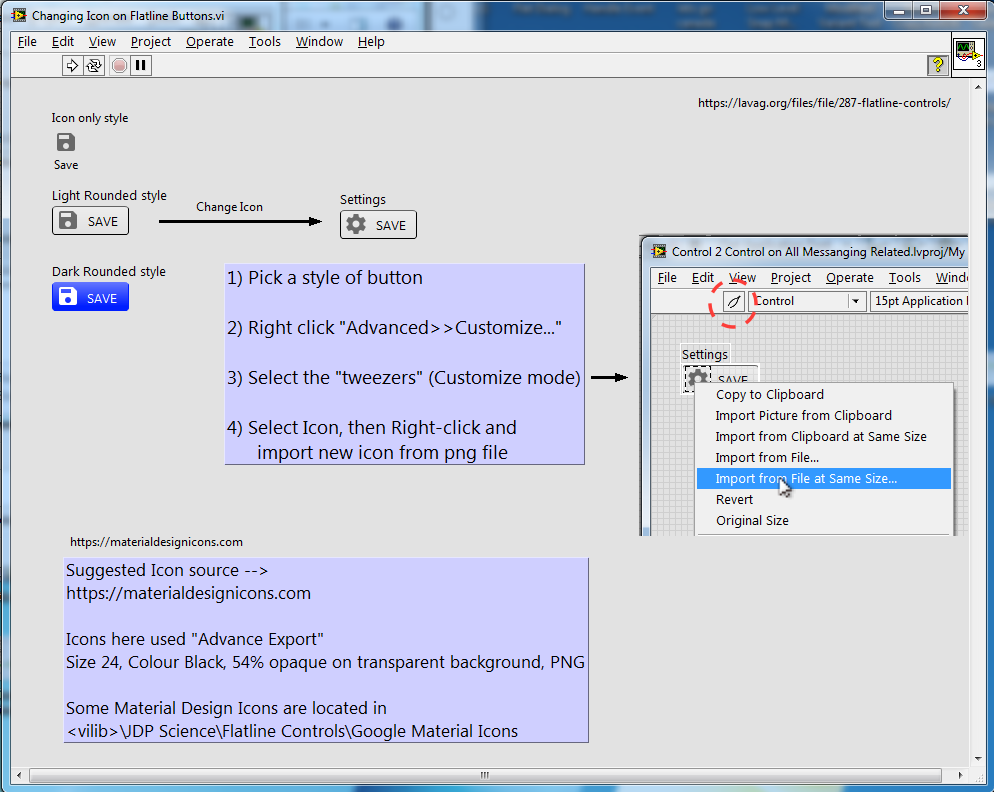
The latest version contains an example, "Changing Icon on Flatline Button.vi” which contains instructions on how to substitute your own icons into the provided icon buttons (which all start with a “save” icon). I did this, rather than provide a suite of ready-made buttons, because there are just too many types and styles of icons.

-

Database Connectivity Toolkit Multi Row Insert
drjdpowell replied to lisam's topic in Database and File IO
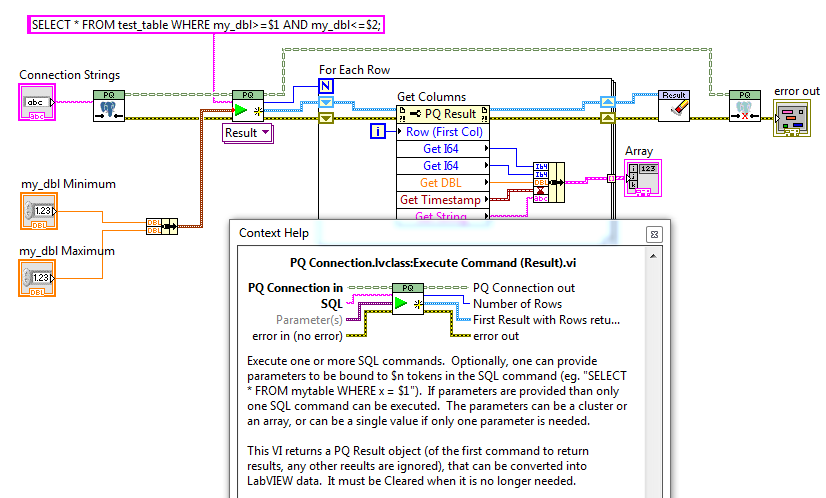
I’ve been working on a wrapper for libpq.dll, which theoretically could be made to work on Linux by just using a libpq.so file, but I have only tried Windows so far. -
I’ll call this beta if you want to give it a try: jdp_science_jsontext-0.2.0.9.vip BSD license.
-
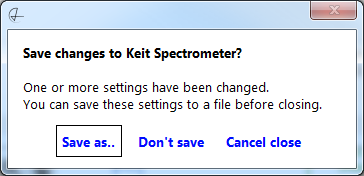
I find the biggest improvement with Flat design is in the simplest of front panels. Here's a dialog box: Here I just used link-style buttons (the square around "Save as.." is placed by LabVIEW as it is bound to the Enter key). I eliminated the window tittle normally on the window frame, and instead placed that text in bold. This makes a very clear, uncluttered dialog box.
-
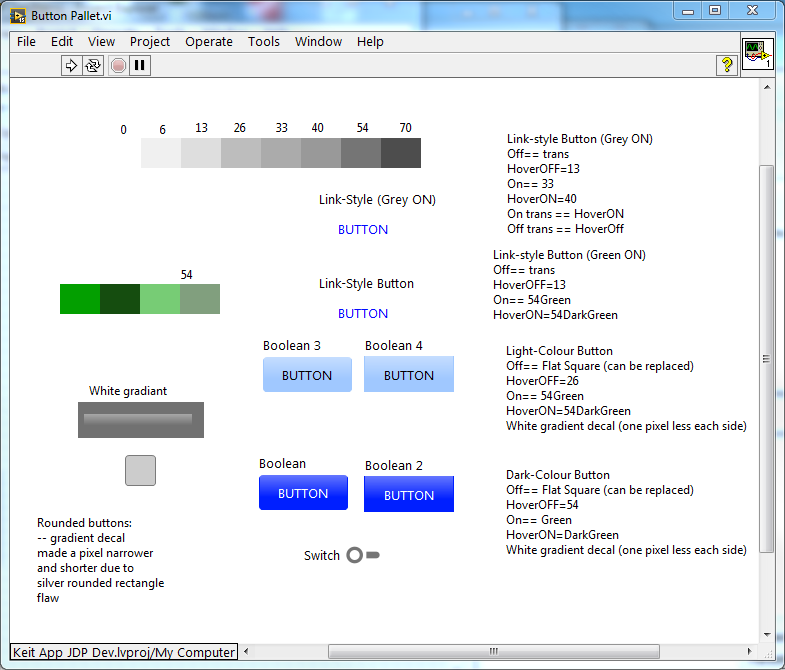
Do you know how to Customise controls? To get mouse-hover effects, I based these buttons on the System controls, which do not support different colours for ON/OFF states. So I instead made the ON state a 4x4 pixel PNG (like the hover states). If you install Bitman from the LAVA-CR, you can use the utility I used to make these PNGs: <LabVIEW>\vi.lib\drjdpowell\Flatline Controls\Utilities\Make small transparent square in PNG.vi Set your desired colour and Alpha transparency (I use a slightly higher Alpha for the Hover states. You can see the "pallet" of colours I used in: <LabVIEW>\vi.lib\drjdpowell\Flatline Controls\Button Pallet.vi To actually use your new transparencies, I'm afraid you have to manually customise the control and swap in the new PNG for the old in the ON state. If you Google you can probably fine a tutorial. Once you learn it it's not that hard.
-
Here is a demo button based on Silver buttons (instead of system buttons). No hover effects, but one can colour ON and OFF state differently, which you can't with system buttons. Flatline Non-hover button.vi
-
Oh, that enumeration. Not sure that would be on the list as only one thing can be written to a file at one time, even by TDMS. SQLite is by default ACID compliant (now that would be on the list), but one can turn that off to get asynchronous disk writes, just like TDMS. And as long as you writes are faster than your busy-handler timeout (I set that at 5 seconds, adjustable) then there are no Busy(5) errors. The issue is just write speed, where TDMS wins.
-
Sorry, what “enumeration”?
-
No, seems to work fine without that, as long as one reading, not writing.
-
Actually, at least up to the 2GB files I’ve tested, the SQLite file gets held in memory by Windows File Cache, so refreshing is fast (though the initial read will be slower with an HDD than an SSD, as will be writing).
-
TDMS is much more specialised than the more general-purpose SQLite. If your use case is well within what it is designed for (and it sounds like it is) then it is likely the better choice.
-
Open Source SW and mailicious intent
drjdpowell replied to Matthew Rowley's topic in OpenG General Discussions
You didn't make them from scratch; you used available components (such as lawnmowers, brakes, engines, etc.) all of which you accepted as not being sabotaged by someone who wanted to kill you. An MOT is a non-onerous test, involving a reasonable set of requirements, so that sounds like a good idea. It would be a LOT of work to pass an MOT without using components manufactured by other people. -
Open Source SW and mailicious intent
drjdpowell replied to Matthew Rowley's topic in OpenG General Discussions
Nobody makes their own car because no-one is trying to sabotage their car, and driving a car built by yourself is extremely dangerous. If you think someone might try to kill you, then you still don’t build your own car. Instead, you verify that no-one has tampered with your car. I was just wondering how that kind of analysis goes with software, and whether management, in it’s insistence on no open source or onerous verification requirements, is actually making the correct choice as far as minimizing risk. -
Open Source SW and mailicious intent
drjdpowell replied to Matthew Rowley's topic in OpenG General Discussions
But which is the bigger risk of this example: A) Someone will sell me a car that has been modified to crash and kill me. B) The car that I build from scratch will crash and kill me. Mitigating (A) by accepting (B) is not necessarily reducing your chance of death. -
Open Source SW and mailicious intent
drjdpowell replied to Matthew Rowley's topic in OpenG General Discussions
I’m not sure intuition is that reliable in such high-importance-but-low-likelyhood things. People die from mundane things like tripping over. -
Open Source SW and mailicious intent
drjdpowell replied to Matthew Rowley's topic in OpenG General Discussions
I wonder how large the risk of malicious code is relative to the risk of serious bugs in code implemented from scratch. -
database What Database Toolkit do you use?
drjdpowell replied to drjdpowell's topic in Database and File IO
Anybody using Postgres who would like to beta test my libpq-based library? It’s similar to my SQLite access library.
-
Search & replace string character without loops
drjdpowell replied to Ano Ano's topic in LabVIEW General
You’re running out of memory because you are copying the giant string somewhere. If you never alter the string, but instead work along it using the “offset” inputs on the string functions, then you can use all the loops you like. -
Oh that IS a use case. Though lookup is much slower than with a Variant-Attribute-based object, it is much faster than doing the initial conversion to that object, so one is well ahead overall if one only needs to do a few lookups.
-
Here's an alpha version to look at, with one example, just to show the API: jdp_science_jsontext-0.1.0.4.vip This is VERY untested.
-
Be careful if you use the NI function to get your binary data back, as it has bug in that will truncate the string at the first zero, even though that zero is properly escaped as \u0000. Png files might or might not have zeros in them, but other binary things do (flattened LVOOP objects, for example).
-
I have only used it that way a bit. And that was basically for recording attributes of a dataset as it passed through a chain of analysis. I was only adding things at a few places before the result got saved to disk/database. The new JSONtext library has Insert functions to add/change values. These are slower than the old library, but not so much as to make up for the expensive conversion to/from LVOOP objects, unless one is doing hundreds of inserts. If someone is using LAVA-JSON objects in such a way, I would like to know about it.
-
I've had a client hand me a 4GB JSON array, so I'm OK for large test cases.
-
Only 125MB/sec, but I was testing calling 'SELECT json_extract($json,$path)' which has the extra overhead of getting the JSON string in and out of the db. I wish I could match 300MB/sec in LabVIEW.
-
I prototyped using an in-memory SQLite DB to do JSON operations, but I can get comparable speed by direct parsing. But using JSON support in a Database is a great option.