
drjdpowell
-
Posts
1,994 -
Joined
-
Last visited
-
Days Won
183
Content Type
Profiles
Forums
Downloads
Gallery
Everything posted by drjdpowell
-
 I would guess it opens the file and reads in the dependancy list, without actually loading the code.
 -
Uh oh. Your right. I hadn’t appreciated this before. I built a test project and library myself (LabVIEW 2011). I used the Application properties to find what VIs are actually in memory as opposed to just listed in dependancies. The unused VIs in a library are NOT actually loaded, but any libraries in dependancies ARE, and if that library is a class, then the contained VIs (and all their dependancies) are loaded. Here “Uses Empty VI" is in the project but not loaded. It uses “Empty VI”, which is in the same library as VI that calls a method of "Cyclic Table” class. None of the three VIs in the chain are loaded, but the Library and Class are. NI really needs to fix the library system; it’s badly broken. Added later: a useful link.

-
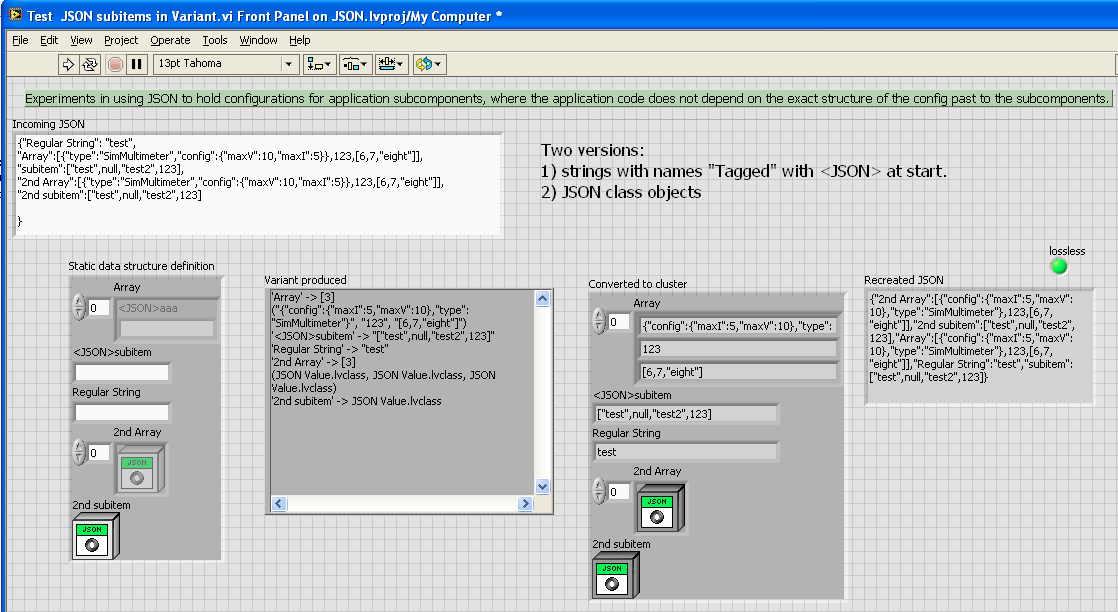
Also see “Test JSON subitems in Variant.vi”. I’ve added the ability to use “JSON Value” class objects in the Variant JSON tools. I should have thought of this first, before using “tagged” string names, so perhaps the tagged string stuff should be dropped.
-
I’ve made an addition that I could use comment on. See “Mixed type array experiment JDP.vi” in the Bitbucket repo. Basically it is about JSON like this: {“instruments”:[{"type":"SimMultimeter","config":{"maxV":10,"maxI":5}}, {"type":"SimVoltmeter","config": {"Voltage":100}}, {"type":"SimDAQ","config": 12.3}] } Here “instruments" is an array of objects corresponding to modules. Each has an identifier, and also a configuration object that varies from module to module. We can’t make a LabVIEW cluster that matches this structure, so at the moment we have to use the lower-level functions to get at it. However, if we have a means of defining a string in a cluster as a JSON string, then we can hold arbitrary JSON subitems in this string. To do this I have added support for a “tag”, <JSON>, at the beginning of the name of any string in a cluster. With this, we can convert the above into a cluster containing an “instruments" array of clusters of two strings, named “type” and “<JSON>config”. Thus we can still work with static clusters, while retaining dynamic behavior at lower levels. Have a look at the example and see what you think? — James
-
Seems a bit strange to be considering which number is most reasonably used as “not a number”, but I note that “-1” is often used in LabVIEW as “not a number” in things like Find in Array. “-1” in U32 is 4294967295.
-
Code-Development collaboration through Bitbucket (GIT and Mercurial)
drjdpowell replied to Ton Plomp's topic in LAVA Lounge
Yes. Source code is on Bitbucket; it is the VIPM installers that are in the LAVA CR. One should also upload the installer to the files section of Bitbucket (though I often forget that). Source code should also be in an as early a LabVIEW version as reasonable (I use 2011), to maximize the number of people who can use it. -
You can also, BTW, take the property-node-in-array sections and put them in a subVI set to run in the UI thread. Running your VI in the UI thread reduced to “Grad” update time from 450 to 250ms (this is because property nodes run in the UI thread, and thread switching is part of the performance problem with property nodes).
-
All the cell color-formatting property node calls in the “Grad” event seems to be your main problem (takes 450ms on my computer). If you added a comparison and only updated changed cells you’d get much better performance.
-
New version posted in the CR. Includes a fix for empty objects.
-
Errors in initialization are passed back to the calling VI, with an error meaning that the actor failed to launch. This seems reasonable to me. And you can handle the error in “Pre Launch Init” if you prefer the actor to launch anyway (note that you can call “Handle Error” n “Pre Launch Init” if you want).
-
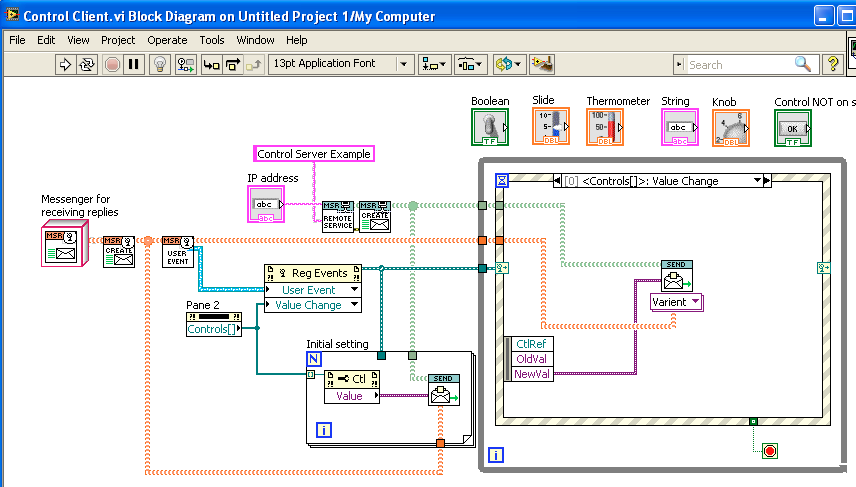
Yes, the main application of this feature is for publishing state information. I have a cluster already with meaningful names and can reuse those names as the message labels. Nice and clear. And I only have to name something in one place, rather than two. You can also use in other places where one is dealing in variants already. For example, the code below connects all controls on a Pane to a remote program via message. Any Value Change event on any control causes a message to be sent using the control name as label (one could use the control’s “Label.Text” property instead in this case, but at considerable property-node overhead). Drop a new control, label it the message label you need to send; job done, with no new coding required. I don’t feel it is worth it to introduce multiple versions, as I’m not likely to use this in 2011. A conditional disable structure was my first thought, until I found you can't currently disable based on LabVIEW version (kudoed your idea). That’s a good idea, though NI really should add a “LabVIEW version” condition (I don’t understand why there isn’t one already). I wouldn’t have agreed with you when the NI functions were 10 times slower than OpenG; but your right, they are getting improved.
-
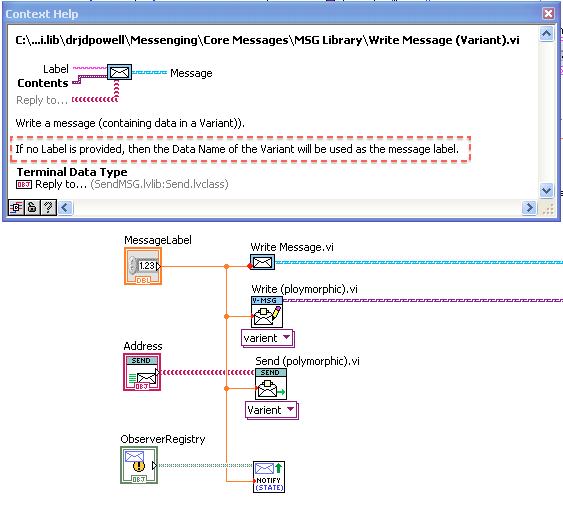
Hello, if anyone is using this package, what version of LabVIEW are you using? And in particular, are you using the feature where messages containing data in a Variant can optionally take the data name as the message label (as seen below)? I ask, because the (off-palette) NI “GetTypeInfo.vi" for determining data name is 10 times faster than OpenG’s “Get Data Name.vi" in LabVIEW 2013, but 10 times slower in 2011. As all my active projects are now in 2013, I am considering switching to using the NI VI (though I am staying with 2011 for package development).
-
XY-graph: programmatically add point "labels"
drjdpowell replied to machyaer's topic in User Interface
Green icons are OpenG toolkit functions. You can install OpenG with VIPM. I just used annotations yesterday to mark things on a graph, and reacquainted myself with their limitations. I think I’ll try your picture solution. -
Powerpoint slides from a presentation I gave at the European CLA Summit: CLA Summit 2014 SQLite.pptx
-
need help dipping my toe into Actor programming
drjdpowell replied to jcarmody's topic in Application Design & Architecture
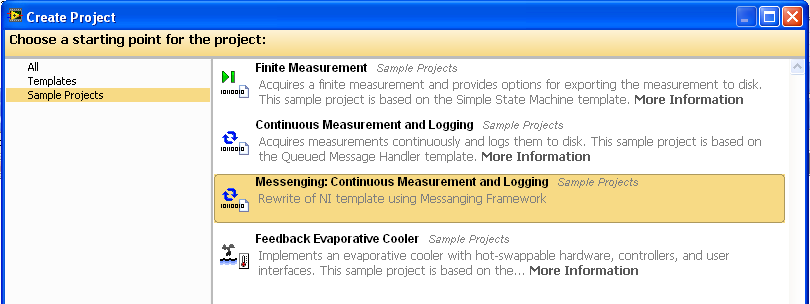
I have recently added a Sample Project to my “Messenging” package that reworks the NI standard sample “Continuous Measurement and Logging”. I didn’t do it to illustrate actors, per se, but perhaps the comparison will help. To me, the key point about “actors” is that they are parallel processes that only receive incoming information via a single communication point. No shared DVRs/FGVs/whatever. Actors are parallel processes, but with design restrictions, restrictions that are intended to make them more robust against the kind of bugs that can afflict multiple interacting parallel processes. -
If I were to spend some more time on probes, the next thing I might do is adapt my SQLite-backed logger to handle messages. That would give unlimited history with search functionality. My current probes do have variable history, but only to the extent of resizing the probe window (so not if you need quite a long history). I really should buildup the variant display to the level of Ton’s “Variant Probe”, but I find most “complicated data structures” in my code become objects, encapsulated against any probing. I also have a preference for small and simple probes, without a lot of controls that take up space or take time to configure, but a “pause” function does seem like a good idea. I have debated adding “trace” functionality into the “Send” function itself (and “Reply” and “Launch Actor”). Theoretically one could add lots of advanced features like tracing which message is in reply to which other message. But this would be a lot of work, and I shy away from loading down the basic framework (I would like the basic messages and messengers to be usable without the higher-level “actor” design). One can, as in this example, build up your own application trace window relatively easily, through having a message logging actor registered for all published information of your other processes. And, being custom, it can also be targeted; showing only a subset of the more significant messages. Thanks for the feedback. Have you considered posting your actor design as an example for others? — James
-
This sample project is now installed as part of version 1.2 of “Messenging”.
-
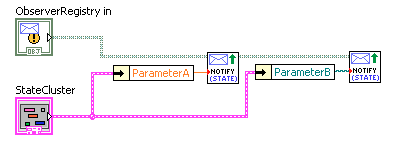
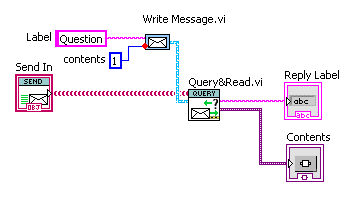
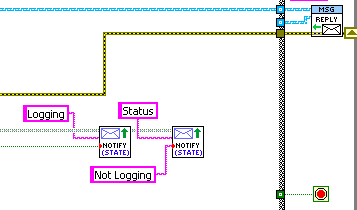
Version 1.2 has the following changes/additions: 1) A sample project that is a rework of an NI standard sample project, to illustrate the differences with using Messenging (original conversation): 2) New polymorphic VIs for writing messages and synchronous “queries” (send message and wait for reply). The new write VI is smaller and lacks error terminals. The new “Query&Read” VI allows immediate reading of the reply message. I deprecated the original “Query” polymorphic VI because of non-consistant error handling. When error messaged are “read”, they return the error cluster through the "error out” terminal; some of “Query”’s instances read the message, and some just returned the unread message. The most common use of “Query” I have found is to issue a command and wait to be sure it has completed without error, so it is desirable to consistently return the error cluster. 3) An internal change; the “ObserverRegister” publication system has been switched from an asynchronous helper actor to a synchronous DVR-based solution. This is to prevent messages sent by “notify” from arriving AFTER later messages sent by “reply” (because notifications goes via the helper actor while replies go direct to final recipient). For example, in the code below from the new sample project, the “Logging” and “Status” messages used to arrive after the “Reply” message.
-
Attached is Version 1.2 with all new features. I will add this to the CR in a few days if there are no objections. Please run this version with your projects to test for errors. lava_lib_json_api-1.2.0.22.vip
-
Could you save it in LabVIEW 2011 please.
-
I have added this to Bitbucket but I have not tested it much. Do you have a Test VI that we can add to the test suite?
-
Perhaps. But most types can be meaningfully converted. A SGL can be a DBL. The number 5.6 can be the string “5.6”. Even the string “Hello” can be returned as a valid DBL (NaN). But returning a Queue refnum as a User Event refnum is invalid. That may not be that important, since the invalid User Event will just throw an error when used,
-
The distinction between reference numbers and reference strings is unimportant; they are references. I’m not sure if it is valuable to include reference type information in the JSON serialization, but if we do, it would be best to do this a JSON Object, rather than special string formatting. Nothing in that case, other than type-checking and some human readability of the JSON. Same as the original encoding one. Why wouldn’t it be?
-
Sticking with the JSON spec, it might be better to encode LabVIEW refnums as JSON Objects: { "DAQmx Refnum": {ref:”SampleTask”, LVtype:”UserDefinedRefnumTag"}, "File Refnum": {ref:-16777216, LVtype:”ByteStream"}, } On converting back, we should throw and error on any type mismatch. This is rather verbose, but encoding refnums should be a rare use case, limited to “tokens” that are passed back to the original sending application where the refunms are valid.
-
Looks like it: