
drjdpowell
-
Posts
1,994 -
Joined
-
Last visited
-
Days Won
183
Content Type
Profiles
Forums
Downloads
Gallery
Everything posted by drjdpowell
-

Self-addressed stamped envelopes
drjdpowell replied to drjdpowell's topic in Application Design & Architecture
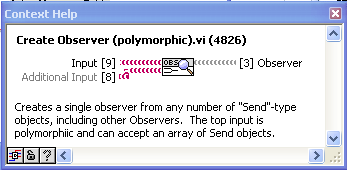
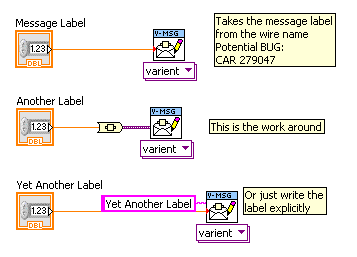
Ben, small note: I see in one of your images that you index over your array of Instruments and individually configure an Observer to substitute a message and then register this Observer with the Metronome. You’ll have less overhead if you take the entire array of instruments, create a single Observer, configure it to substitute a message, and register it. Observers can hold any number of “Send” objects internally. To make your array into a single Observer, use what is now called “Create Observer (polymorphic)” but was then called something like “Make Observer” or “Add Observer”. Another small note: There is a bug that is a problem for a feature that you might not be using but should know about. For Variant-type messages, one can not fill in the label and let the message use the variant data name as the label. But a bug in converting to variant sometimes doesn’t take the right name:
-
Self-addressed stamped envelopes
drjdpowell replied to drjdpowell's topic in Application Design & Architecture
The new version uses the VI qualified name, rather than the path. Hopefully, this will work better. Some of those are experiments, since this framework kind of grew over time through trial and error, so be careful. There are two ways that one can get information out of a launched Parallel Process: (1) having it respond to a message sent to it, or (2) “registering" with it to have “notification” messages sent whenever something happens (an “event”) or the state of the actor changes (“state”). These are separate methods; one could probably just use one or the other. My examples are perhaps overloaded with trying to do both, and that might be confusing. But then, a reusable component may be more useful if it can communicate in a variety of ways. I actually tend to rely on the Observer Registry stuff primarily, but having replies can still be useful, especially for synchronizing things (as you do in your application). Exactly. Note, however that this is NOT a global thing like a named queue or global variable. To “register” to receive a notification one must send a registration message to the Parallel Process in question. You do this in your App when you register for “MetronomeTick” events. An “Event” is, well, an event. ”Tell me when this happens”. “MetronomeTick” is an event. If you look at the “Metronome” Block Diagram as an example, you’ll see that you can also register to receive Error Messages, and the “Shutdown” event which is the last thing sent when the Metronome shuts down. A “State” Notification is slightly different. Here, you don’t want to be told when something happens in the future, but what something is right now, and to be notified of any changes. Metronome has a “MetronomePeriod” State notification. If you were to register to receive this notification, you would immediately be sent a message containing the current period (the Observer Register remembers the last state message so it can notify any new observers). You would also be sent a message any time the state changed. Nothing happens. Neither “Notify Observers” nor “Reply” throws any errors if no one is listening. If you launch an actor and don’t subscribe to its published notifications or bother to listen to its replies that is not the responsibility of that actor. It is the job of the code launching the actor to decide who should receive messages from it. This is a deliberate design choice; actors are reusable components that are not coupled to the code that launches them. They don’t demand anything and only provide services. If you don’t use all the services… whatever. In your code, for example, “Metronome” attempted to reply to your “SetPeriod” message, but you attached no return address. It also published its period and a shutdown message, but no one asked to be notified of them. No problem, “Metronome” doesn’t mind. It stands ready to provide these messages, should the code that launched it want them. You could, for example, register your UI to receive “MetronomePeriod” state updates so you could display the period. Or you could change your “SetPeriod” message from a “Send” to a “Query” (that waits for a reply) to check that Metronome did what you asked (if you try to set the period less than 10 ms, for example it will comeback saying 10, because that is the lower limit). Queries are good for making sure something has happened before continuing; if you sent a “SetPeiod” message by accident, the reply would be the Error Message “Unhandled: “SetPeiod””, code 52. This message would also be published to anyone registered to receive error messages. Not necessarily. My simple examples mostly involve commands that change the actor’s important state (“SetPeriod”, etc.), so they naturally involve a Notify. But one could have commands that don’t change state, or the state can change for some reason other than a command. And it is OK to have actors that don’t have an Observer Registry at all, if that isn’t really needed. — James -
Self-addressed stamped envelopes
drjdpowell replied to drjdpowell's topic in Application Design & Architecture
Hi Ben, It’s late where I am, but I’ll try and reply tomorrow, particularly with a better description of what the Observer Register is for. Your code looks good. — James -
I too didn’t like that “Low Coupling Solution”. I spent some idle time trying to think of a way to make the “Zero Coupling Solution” simple enough that one wouldn’t ever need to consider the “Low Coupling Solution”. After I while I realized: it already is simpler! Not trivial to see at first. So I think it would be better if the documentation never mentioned the “Low Coupling Solution”, and instead concentrated more on demonstrating how to do zero coupling, and presented it as the standard way to use the Actor Framework. In fact, with a simple guideline, one could write “High Coupled” actors in such a way that they could later be easily upgraded to zero-coupled actors. I’ll try and get this suggestion, with more detail, in the 2012 beta forum (once I’ve figured out how to download the beta software ). — James
-
Need to get me some of that some day.
-
Object serialization (XML) and LabVIEW
drjdpowell replied to PaulL's topic in Object-Oriented Programming
That’s what I thought, but AQ stated: -
Note to Darin on in his Champion’s profile picture: I recognize that hardware! Axions! Or search therefore. Did a very little bit on it as a Post Doc long ago. I’m very, very least author on an axion Phys Rev Lett from 1998 (I see from my CV that you're second author). Found those things yet? — James
-
Object serialization (XML) and LabVIEW
drjdpowell replied to PaulL's topic in Object-Oriented Programming
I was under the impression (from a post somewhere by AQ) that lvclass references work in run-time as of 2010. -
closed review Suggestions for OpenG LVOOP Data Tools
drjdpowell replied to drjdpowell's topic in OpenG Developers
Oh good! Having to put those terminals in was annoying. I second the suggestion to go without the terminals. Though we might want a temporary note in the VI descriptions and/or on the block diagrams explaining this issue. — James -
Oh, man… The number of times I’ve double clicked on a subVI, double clicked on its icon to bring up the editor, made a copy, closed the editor, opened another VI’s editor, pasted. What a waste of time!
-
Self-addressed stamped envelopes
drjdpowell replied to drjdpowell's topic in Application Design & Architecture
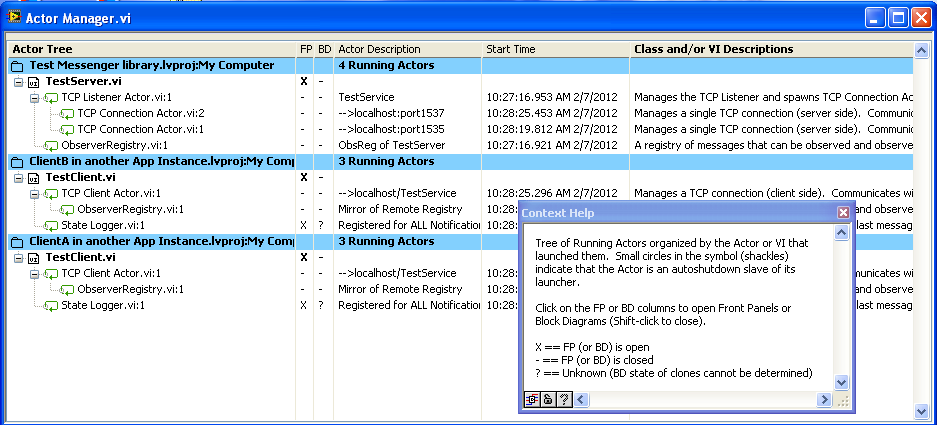
Oh, the new version will also contain the “Actor Manager” (I’ve started to call my “Parallel Process” things “actors”, it’s a lot shorter and is an established computer science term) which makes knowing what’s running, and accessing the Front Panels or Block Diagrams, much easier. Below is a tree of actors running TCP communication tests (same computer, but three different projects): If one tries something complicated, with umpteen copies of “Observer Register” or “Metronome” used in different ways, this really helps diagnostics. As does being able to quickly open the Block Diagram of any actor and place the “MessageTable” probe to observe the incoming message stream. — James
-
Self-addressed stamped envelopes
drjdpowell replied to drjdpowell's topic in Application Design & Architecture
Hi monzue, thanks so much for your highly positive feedback! Gives me the impetus to push forward and get a new version in the Code Repository. I wasn’t aware of anyone using this, and I apologize in advance as updating your code to use the new version will involve a couple of tedious hours tracking down and replacing VI’s that have moved/been renamed/put in a different library. I’ve done a lot of reorganization. It looks scary the first time you open a VI that can’t find some of its classes, since all the class methods show up as question marks, but it is usually easier than it looks to fix by just replace the missing class constant, with all the methods magically reappearing. I promise to make the next version more finalized so you don’t have to do it again. Alternately, feel free to take the previously posted version and build on it to make it your own. The new version will have the TCP Messengers shown above, though, which is a major new feature if one has a distributed application (unfortunately, I don’t have a distributed application at the moment to really test it on). It will also have the above "Asynchronous Dialog box” and Futures. BTW, what LabVIEW version are you using? I have recently upgraded from 8.6 to 2011, and I was going to use the new “Async Call by Ref” node of 2011 in place of the “Run” method for launching VIs (this has very important performance advantages), but I could try and keep a separate 8.6 version available. It’s more (unpaid) work for me, so I need to know if there’s a need. Thanks again, — James BTW on the Actor Framework: My Messenger library is the work of a lone programmer who’s interested in easy use of dynamic VIs talking to each other. The Actor Framework comes from a very different perspective, that of a framework for a diverse team of programmers working on a large project, where restrictions are needed to prevent hard-to-see flaws compounding into severe problems. I don’t have the multi-programmer experience to analyze my Messenger library from that perspective. -
Not trying to hassle AQ. OK, a hopefully constructive hassle. One problem with complex designs is that people rarely take the effort of digging into them enough to make a constructive criticism of them. I was lamenting that fact one day (since I have complex design posted here myself) and I thought I really should make an effort. I’d be happy for AQ to point out the security flaws in my own, made by lone developer with an eye only for flexibility, designs. Or of other worthy ActorFramework-like targets, like mje’s “MessagePump". — James
-
Selecting which child class to cast to.
drjdpowell replied to SteveChandler's topic in Object-Oriented Programming
Ah yes, this makes a lot more sense. It does appear to be the command pattern. Call your “execution” class “Command for <name of class command is for>” and your “children” “Command A”, etc. Your dynamic VI dispatches off of the Command child class, but the actual work is done with methods of the class the command is for. Here is a command-pattern execute method of mine, looking very similar to yours: Note, btw, that one can put needed parameters inside the command object, such as the “Message” in my example. — James
-
Selecting which child class to cast to.
drjdpowell replied to SteveChandler's topic in Object-Oriented Programming
Still not understanding. The dynamic VI to execute is determined by the class of the object passed along the wire. It almost looks like you are trying to change the class of the object coming in through the “Parent.lvclass” control terminal. Or that you want to be able to call the VI for ClassA on an object of Parent Class. One can’t do either off those things. -
Selecting which child class to cast to.
drjdpowell replied to SteveChandler's topic in Object-Oriented Programming
The difference between objects and wire data types, and the different possible meanings of “coercion”, can be rather confusing. -
Selecting which child class to cast to.
drjdpowell replied to SteveChandler's topic in Object-Oriented Programming
Not really, I’m afraid. The “too more specific class” function only affects the wire types. Your saying “stuff the object on this parent wire into this child wire, if possible”. But though your selector returns a child object, that’s at runtime, not edit time, where the wire type out of the index array can only be the parent wire. So “too more specific class” isn’t doing anything here. Does that help? I can’t actually tell what you want to happen. Actually, what are you using to get the name of the class in your subVI? Is that what isn’t working? — James -
Object serialization (XML) and LabVIEW
drjdpowell replied to PaulL's topic in Object-Oriented Programming
What about using the LVClass references (like here) to determine the default object’s data clusters? AQ says that LVClass references are very slow, but, one could keep a look-up table of the needed information inside the Flattening VI (i.e. each object type needs to have its default info determined only once). I was looking into this stuff a few weeks ago, and it seemed to me that one could get around the “default” issue this way. Then one could make a VI that flattens an object, and then fills in the missing default pieces. One could also make VIs that alter the cluster values this way (I was actually thinking of making a VI that could take objects of different types, such as parent/child, and copy from one the the other all the common levels of cluster data). I never did any actual tests, so there may be a roadblock, but I think LVClass references can give one the information one needs. — James -
Who you calling fast? That’s the first time I measured it and I thought it was slow. Something built for speed would be much faster. But Property Nodes, and anything that runs in the UI thread, are REALLY slow. Using a waveform for individual reading does NOT seem like a good idea. Why not just store two channels: “Measurement” and “Measurement_Time”? That’s what I do. I’ve never noticed a problem with subpanels, but I’ve never looked into the speed. I’ve never done anything like that. Usually, I have most of the detail of an instrument in it’s own Front Panel, with only the key summary on a main screen of the whole application. So, for example, if I have a temperature controller, the main app might just show the temperature, the set point and some other summary info (like “ramping”). Clicking on the temperature indicator (or selecting from a menu or whatever) would bring up the “Temperature Controller Window” (could be in a subpanel) with a full set of controls (PID settings, maximum temperature, alarms) and indicators (chart of last ten minutes temperature and heating). The secondary window would be specific to that controller, so it doesn’t need adjusting, while the main app window would have only the general info that doesn’t need to be changed if you use a different controller. Another technique is to realize that most simple indicators are really just text, or can easily be represented by text, and thus one can do a lot with a multicolumn listbox or tree control to display the state of your instruments. — James
-
Actually, I’d expect sending a message via a queue and updating a terminal to be faster than using an indicator reference and a property node. Property nodes are quite slow. I did a quick time test with the messaging system I use (which is very similar to Lapdog); a round-trip command-response (i.e send a message via one queue and get a response back via another) was about 250 microseconds, or about 130 microseconds per leg. A single Value Property node on a Numeric indicator was between 300 and 500 microseconds. Also, note that a delay is unimportant if it’s equal at each end; the relay indicator will still be on for 50ms. One could also switch to indicating heater duty cycle (x%) rather than flash an LED. — James
-
Shortcut Menu Utility VIs for OpenG?
drjdpowell replied to drjdpowell's topic in OpenG General Discussions
Ah. I don’t use it to change the menu at run time. I use it to make adding/chnaging options very easy. If I needed a new option, say display the X scale in photon energy instead of wavelength, I would just drop a boolean in the Options cluster and name it “Display X axis as photon energy”, and go change the display update code to read that option. Job done. No need to manually configure a runtime shortcut menu, then write code to interpret the tags and set the appropriate state parameter in the shift register (with all the additional potential for bugs/misspelling). Also, if the Enums are type-defs, the menu will automatically adjust to changes in the type-def, without me having to manually update the runtime menu. Basically, it avoids doing something (defining the options) twice, in the code and in the menu setup, and avoids the necessity of custom interface code between the two. -
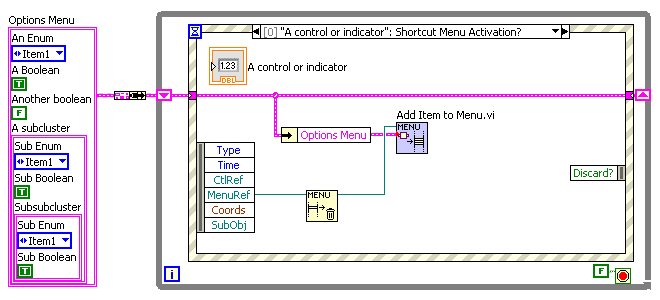
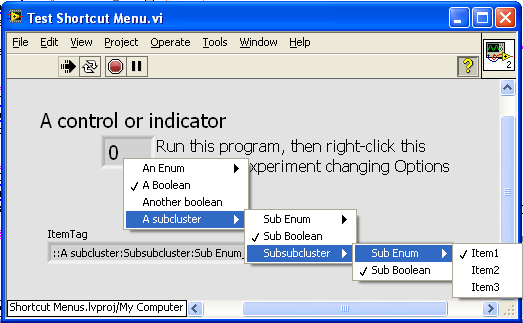
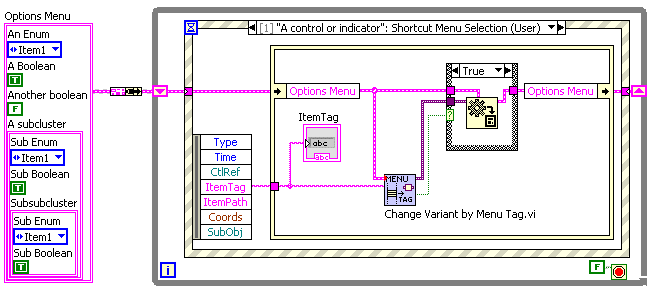
Hello, I use shortcut menus a lot, particularly for setting display options on graphs and charts. I have a pair of VIs that I use for this that leverages the variant data tools of OpenG, and I wondered if they, or something like them, would be a useful addition to OpenG. I’m not sure if they are quite right, but even if they are too specialized for my way of using menus, perhaps there are other more general VIs that exist for helping configure menus. So here they are for comment: The basic use case is shown in the top image; I have a shift register of program state parameters, including a number of options. When the User right-clicks on a control/indicator (a numeric in this example, but more usually it is a graph or listbox) the options are inserted into the shortcut menu via the VI “Add Items to Menu”. This VI can handle booleans, enums, and clusters thereof. The second image is the front panel and the pulldown menu that results. The third image shows the Shortcut Menu Selection case, where a second VI, “Change Variant by Menu Tag” (needs a better name) interprets the selected tag and updates the cluster of options accordingly. It also has a “Changed?” output that can be used to trigger redisplay with the new options. As I said, I’m not sure if these are general enough for OpenG, but perhaps someone else has a set of reuse menu VIs that might be more suitable. Menus are a UI feature that is very valuable, IMO, and they could do with some OpenG support. — James Shortcut Menu Utilities.zip
-
Need LVOOP Object VIs in lvdata library
drjdpowell replied to Jim Kring's topic in OpenG General Discussions
I noticed that the first call to either “GetTypeInfo” or “Get LV Class Path” is very slow, between 3 and 16 milliseconds, but only for the first one of the two called. So they must both access the same (very slow on first call) thing. Quick Tests: 1) Stub the Variant —> faster 2) set UI Thread —> much slower! That could be it. -
One could use a symbol in the label to indicate excluded controls, like “_Numeric”.
-
Need LVOOP Object VIs in lvdata library
drjdpowell replied to Jim Kring's topic in OpenG General Discussions
Takes a coffee break half way though. NI’s not paying it enough for “high performance”.